What Is a Business Analytics Course?
A business analytics class teaches students how to analyze data to measure business performance, address problems, and inform decision-making.
Business now applies sales data, customer behaviour, financial information, operational metrics and market intelligence to spot trends and steer decisions, instead of relying solely on gut instincts.
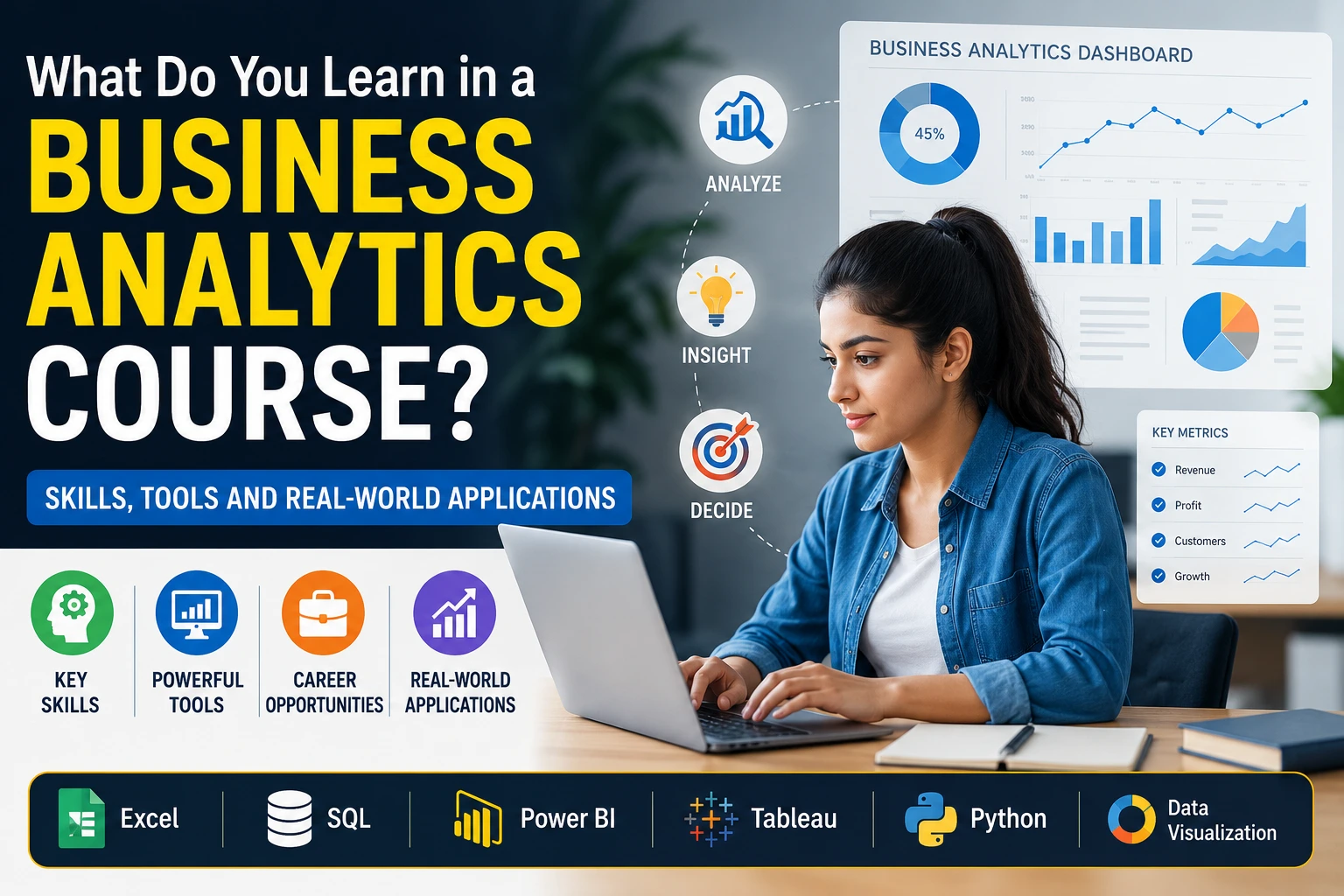
Typical courses will involve a combination of business knowledge, statistics, data analysis, visualisation and technology. It may also cover SQL, Excel, Power BI, Tableau, Python and business intelligence depending on the provider.
What do you study in a business analytics class?
Generally, programmes are a good blend of the following five core areas:
- Issue solving in business
- Collecting and preparing data
- Statistical treatment
- Data visualisationand reporting
- Business communication and decision-making
The syllabus for the business analytics course is different for different universities. But they get a mix of theoretical and practical assignments.
Business Analyst Subjects:
Business analyst subjects are:
- Introduction to Business Analysis
- Probability, statistics, and quantitative methods
- Microsoft Excel
- SQL and databases
- Data visualization
- Business Intelligence
- Requirements elicitation
- Building Dashboards
- Fundamental predictive analytics
- Business reporting and communication
Some of the courses in business analytics from India will also cover Python, Machine learning basics, financial analytics and customer analytics.
Which Tools Are Used?
Technology is an important part of modern analytics work. A practical programme may introduce:
Tool What students use it for
Excel Analysis, calculations and reporting
SQL Querying and managing data
Power BI Interactive dashboards and business intelligence
Tableau Data visualisation
Python Data analysis and automation
Google Sheets Collaborative analysis
CRM/ERP data Understanding customers and operations
Students do not need to master every tool immediately. A better approach is to learn the fundamentals and then build practical projects around commonly used platforms.
How are business analytics functions delivered?
A typical business analytics process looks like this:
Business problem → Data gathering → Data cleaning → Analysis → Visualization → Insight → Business decision
For instance, an online retailer finds that its sales have dropped.
An analyst could:
- Analyze sales history.
- Group customers by region, activity level.
- Detect products that are falling out of favor.
- Test conversion rates.
- Develop a power bi dashboard.
- Report their findings to management.
- Advise a course of action based on the evidence.
This applied process to solving problems is also a key reason why employers look for analytical thinking in addition to technical skills.
Applications of Business Analytics in Everyday Life
Business analytics is now a part of every industry and department.
Marketing: Companies analyze customer behavior, campaign performance, and conversion rates to make better marketing decisions.
Finance: Analytics can be used to track spend, analyze performance and assist with forecasting.
Retail: Retailers leverage data to anticipate product demand, customer preferences, and the success of their inventory.
Human Resources: HR departments can track recruitment, employee turnover, and workforce trends.
Operations: Companies apply analytics to track the efficiency of production, supply chains, delivery, and even resources such as energy and water.
Business Analytics vs Data Analytics vs Data Science
These fields overlap, but their focus can differ.
Area Main Focus Typical Tools
Business Analytics Business decisions and performance Excel, SQL, Power BI
Data Analytics Finding insights from datasets SQL, Python, Tableau
Data Science Advanced modelling and prediction Python, ML, statistics
A data science and business analytics course may combine elements of these disciplines, but students should check the curriculum carefully before enrolling.
Advantages of Studying Business Analytics
A rigorous program can enable students to cultivate:
- Analytical thinking
- Problem-solving ability
- Abilities in data interpretation
- Reporting and dashboarding capabilities
- Business communication
- Technical confidence
- Decision-making skills
- Portfolio-ready project experience
For the students in Delhi, a course that would train them with hands on assignments and industry tools would definitely be more helpful than a purely theoretical one.
Business Analyst Course Fees and Duration
The fees for business analyst course and business analytics course fees vary from institute to institute. The price may vary depending on the provider and the duration of the training as well as the course format , type of certification and the contact projects.
In the same way, business analyst course duration ranges from few days workshops to months long professional courses.
Before you compare the prices check this the full value for money:
- Curriculum content Quality of teaching
- Method of assessment
- Availability and cost of placements
- Career support and guidance
- Additional study options
- Length of course
- Additional information
- Practical projects
- Trainer expertise
- Live vs recorded learning
- Evaluation methods
- Career support
- Certification
- Access to learning materials
Cheaper is not always better value, and a higher price does not necessarily mean better results.
Why Take an Online Course?Is an Online Course Right for You?
A business analytics online class may be appropriate for students who require flexibility while studying. Online courses also enable you to go back to lessons and use the tools as often as you like.
Nonetheless, students may want to verify whether the course features:
- Live instruction
- Hands-on assignments
- Projects feedback
- Actual datasets
- Answering question support
- Well thought-out assessments
- Career advisory services
And the same goes when you are looking at data analytics courses online, cloud computing online courses, or any other technology courses: focus on what you will be learning, NOT on the marketing hype.
How to Select a Business Analytics Course
Apply this five step approach:
Inspect the syllabus: Ensure it has a good balance of basics of analytics and hands-on tools.
Look for projects: Are they realistic business problems, or just quizzes.
Evaluate the trainer’s qualifications: Look for industry experience and academic qualifications.
Era Compare course delivery: Which delivery mode – classroom, live online or self-paced do you prefer ?
Career support: Find out what placement or career support actually means.
Lone Star Academy could be an option for Delhi students who are seeking to learn business-centred analytics but they should also consider the options from the other providers and compare their syllabus, mode of delivery, and support.
Common Mistakes Students Should Avoid
Avoid these errors when choosing an analytics course:
- Selection on the basis of certificate only
- Disregarding the syllabus
- Learning the tools but not the business problems
- Don’t expect a job, build your practical skills
- Buying a course using price as your sole criteria
- Mixing up business analytics with niche areas within advanced data science
- Don’t slack on SQL, Excel or visualisation
- No project portfolio
How to Maintain Your Analytics Skills
Analytics evolves as the tools, platforms and business needs evolve. After you take a course, keep your skills up to date by:
- Creating new dashboard projects
- Practising SQL regularly
- Tracking analytics case studies
- Using public datasets
- New PowerBI or Tableau features
- Presentation Skills Enhancement
- Study current business trends.
Consider the certification as a marker, rather than your final destination.
Expert Tips in business analytics course
1. Prioritise projects over certificates
When you can show a project or that you actually applied a solution to a business problem, that’s more valuable than just having a certificate.
2. Understand the business context
Good analysts are not just spreadsheet jockeys. They know why a business problem matters.
3. Build tool confidence incrementally
Start with Excel and SQL, then go into visualisation and programming, whichever best suits your career aspirations .
4. Practice articulating insights
You also have to be able to explain those discoveries clearly to “people who lack the capability to understand the technical nuts and bolts.”
5. Match course information
Before you settle on a business analyst training institute in India, don’t just take the fees and promotional claims at face value. It is about Curriculum, Projects, quality of teaching and support.
Conclusion
This course in business analytics is for students interested in gaining a practical understanding of how data is used by organisations to support decision making. The best programs are those that teach business fundamentals alongside tools you use day-to-day, like Excel, SQL and Power BI, that allow students to work on solving real business problems.
For learners in Delhi The Best Match for your learning needs should be based on career objectives, learning style, budget, and the amount of hands-on training you want. Students have multiple providers, such as Lone Star Academy, to choose from while exploring their alternatives.
Than picking a course simply based on it promises certification/placement assistance, have a look at the business analytics syllabus, projects, tools, trainers, duration of the course and overall worth. Having a good foundation and practicing regularly with a portfolio of real work can really help make your learning more useful down the road.
FAQs
What is a business analytics course?
A business analytics course teaches students to analyse business data, identify patterns and communicate insights that support better organisational decisions.
What are the main business analyst subjects?
Common subjects include business analysis, statistics, Excel, SQL, data visualisation, business intelligence, requirements analysis and reporting.
Is a business analytics course suitable for beginners?
Yes. Many beginner-friendly programmes start with fundamentals before introducing SQL, dashboards, statistics and other analytical techniques.
How long is a business analyst course?
Business analyst course duration varies by provider and curriculum, ranging from short intensive programmes to structured courses lasting several months.
How much do business analytics courses cost?
Business analytics course fees vary according to duration, delivery method, projects, certification, mentoring and career support offered by the training provider.
Is an online business analytics course worth it?
It can be valuable when it combines structured teaching, practical projects, feedback, relevant tools and career support rather than relying solely on recorded lessons.
Do business analysts need coding skills?
Not always. Many roles rely heavily on Excel, SQL, requirements analysis and communication, while programming becomes more useful for advanced analytical work.
What tools should a business analytics student learn?
Excel and SQL provide a strong foundation. Power BI or Tableau can develop visualisation skills, while Python is useful for more advanced analysis.
Is business analytics the same as data science?
No. Business analytics generally focuses on using data for business decisions, while data science often involves more advanced programming, modelling and machine learning.
What projects should I complete while studying business analytics?
Useful projects include sales dashboards, customer segmentation, marketing performance analysis, financial reporting, inventory analysis and business performance dashboards.