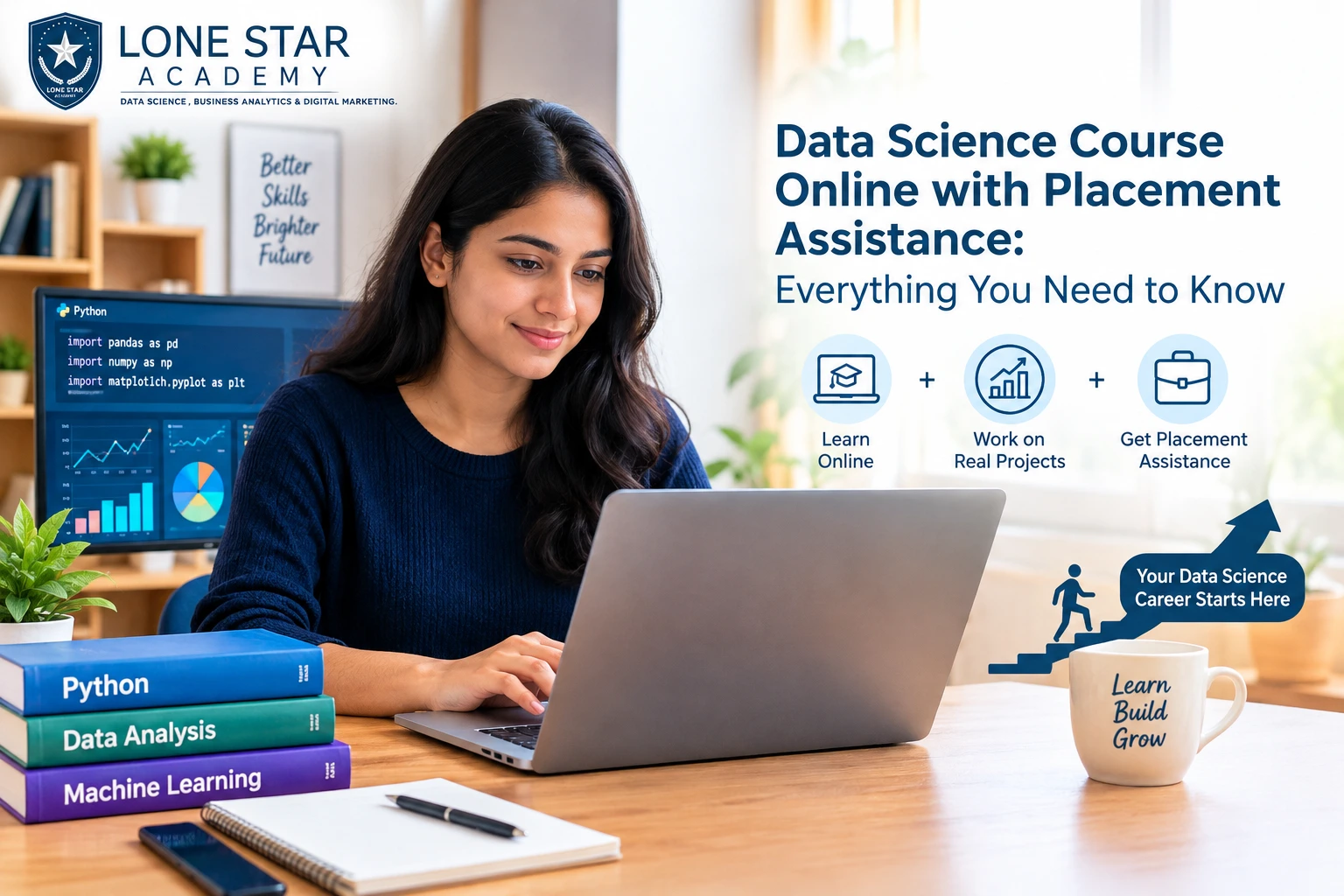
The ability to harness data has become an integral part of how businesses make decisions, understand their customers, and enhance their services. Therefore, it can land you roles in many industries with skills in data analysis, Python, statistics, and machine learning.
Still, learning these tools is only half the battle preparing for a career in data science. It is also important for students to work on projects, look for hands-on experience and actual work experience and learn how to find proper positioning as well.
Data science courses online with placement allows the learning of technical skills and career preparation. The right program should provide a clear structure, practical assignments, and realistic placement assistance. One training program and option that can compare to other training programs, looks into more career-focused courses is Lone Star Academy.
What Is a Data Science Course Online with Placement Assistance?
A data science course online with placement assistance is a training program that teaches learners the skills and should know how to gather, analyse, interpret, and use data, as well as preparing them for career opportunities.
These courses normally combine technical classes with hands-on assignments and career services. According to the provider, interview preparation, resume feedback, projects review and/or job application assistance may be provided.
Key features to look for
- Technical Training: Python, SQL, statistics, Data analysis, and machine learning basics.
- Hands-on Projects: Tasks using real datasets to solve real-world business problems.
- Flexible: Online or recorded classes depending on your course.
- Grading Tool: Coursework, quizzes, and project rubrics.
- Work readiness: Showcasing your CV, mock interviews, and career opportunities counseling.
Before enrolling, check which features the provider actually offers. Placement assistance can improve job readiness, but it does not guarantee a job.
Why Is Data Science Training Important?
This process is what allows organisations to extract value from raw data. Companies harness this information to gain insight into customers, learn their behaviours and transitions, recognise patterns, production demand and many more for operations enhancements.
For example, an e-retailer can use previous purchase data to find out which items are the most popular. A bank may identify suspicious activity by learning transaction patterns. Data analytics in a healthcare organisation can help understand demand for services.
A structured analysis course in data science empowering with placements can bring in the mix of technical and analytical skills required to work on similar issues.
Who should consider this training?
A data science program may suit:
- Students and fresh graduates exploring technology careers.
- Working professionals planning a career change.
- IT professionals interested in analytics or machine learning.
- Business professionals who want to improve their data-handling skills.
- Analysts who want to expand their technical knowledge.
You do not necessarily need an advanced mathematics background to begin learning. However, basic mathematics, logical reasoning, and a willingness to practise regularly will help.
What Will You Learn in a Data Science Certification Course?
A good data science certification is promoted as starting with the basics and moving towards implementation.
Skill or subject - What you learn - Practical application
Python - Programming and data manipulation - Automating data tasks
SQL - Retrieving information from databases - Analysing customer records
Statistics - Understanding distributions and relationships - Interpreting business trends
Data cleaning - Handling missing and inconsistent values - Preparing reliable datasets
Data visualisation - Creating charts and dashboards - Communicating findings
Machine learning - Building and evaluating predictive models - Forecasting and classification
Projects - Applying multiple skills together - Demonstrating job readiness
Courses that go further into data science teach extra topics, such as time-series forecasting, deep learning, natural language processing, and model deployment.
For instance, a learner could take a series-on using historical sales data to develop a sales forecasting project. The project could have included cleaning the dataset, exploring patterns, training a model, and justifying the results in a concise report.
When you review programs, look for skill-based projects that push you to say not just what predictions your model is making but also the impact of the result in respect to the business.
Types of Data Science Courses
The most appropriate course will be influenced by your present level of knowledge, budget, and study hours as well as what you hope to do with the course.
Course type - Best suited for - Main focus
Beginner course - Students and newcomers - Python, statistics, and data analysis
Certification course - Learners seeking structured training - Core concepts and assessed projects
Advanced data science course - Learners with foundational skills - Machine learning and specialised methods
Online course with placement assistance - Job seekers and career changers - Technical learning and career preparation
Short-term specialised course - Existing professionals - Specific tools or techniques
Make sure you meet the prerequisites before making your selection. An advanced machine learning course may be tough to follow unless you already know Python, statistics, and data manipulation.
How Does Data Science Training with Placement Work?
A training course with placement in the field of Data science typically involves a sequence of learning and career-development steps.
- Learn the fundamentals: Study programming, statistics, databases, and data analysis.
- Practise with assignments: Apply concepts to exercises and sample datasets.
- Build projects: Create work samples that demonstrate your problem-solving ability.
- Prepare your resume: Highlight relevant technical skills, projects, and experience.
- Practice interviews: Review SQL queries, Python problems, statistics, and project explanations.
- Apply for suitable jobs: Use job boards, employer websites, professional networks, and any placement support provided by the institute.
Placement support varies between providers. Ask whether the program includes interview scheduling, employer introductions, job referrals, or only general career guidance.
Benefits of a Data Science Course Online with Placement
Online learning can level the playing field for acquiring technical education which is now even more viable for working professionals and students with competing commitments.
Some key benefits:
- Flexible learning: Study around work, college, or personal responsibilities.
- Practical experience: Develop a portfolio through assignments and projects.
- Career guidance: Learn how to present your skills to potential employers.
- Skill development: Build knowledge in programming, analytics, and predictive modelling.
- Broader access: Explore courses without needing to relocate to a training centre.
However, it does take consistency to learn online. Autonomous viewing of lessons, in most cases, will not be enough. You need to code, solve problems independently and look back on your errors during the program.
Career Opportunities and Applications
Data science skills are valuable in finance, retail, health care, logistics, technology and other areas.
Career paths may include:
- Data Analyst
- Junior Data Scientist
- Business Intelligence Analyst
- Machine Learning Associate
- Data Science Associate
The roles you will be eligible for depend on your educational background, technical skillset, project portfolio, and what the employers need. While some positions may require a degree in a quantitative or technical field, others may consider relevant skills and experience.
How data science is used in business
- Retail: Forecasting and segmentation of sales.
- Finance: Risk analysis and fraud detection.
- Healthcare: Forecasting demand and operational analysis.
- Manufacturing: Quality monitoring and predictive maintenance.
- Marketing: Customer behavior analysis and campaign measurement.
An excellent portfolio involves explaining how you approached a problem, the data you prepped, the method you picked, staged your results, and how you communicated your findings.
Online Data Science Courses vs Classroom Training
Both online and classroom learning can be effective, but its success depends on your schedule, how you learn best, and the need for direct help.
Factor - Online training - Classroom training
Flexibility - Often higher - Usually follows fixed schedules
Location - Learn remotely - Requires travel to the centre
Interaction - Depends on live sessions and support - Often allows direct interaction
Learning pace - May offer self-paced options - May follow a set pace
Best for - Remote learners and busy professionals - Learners who prefer in-person teaching
Whichever format you choose, look for accessible instructors, useful feedback, hands-on projects, and a clear course plan.
How to Choose the Right Data Science Course
Use this checklist before paying for a course.
- Does the syllabus cover Python, SQL, statistics, and data analysis?
- Are projects included in the curriculum?
- Can you review a sample lesson or attend a demo?
- Are the instructors' qualifications and experience explained?
- Is the certification process clearly described?
- What exactly does placement assistance include?
- Are fees, taxes, instalments, and refund terms transparent?
- Can you speak to previous learners or review credible feedback?
- Does the schedule fit your work or study commitments?
Learners comparing a data science institute in Delhi need to account for commuting demands, the expanse of the classroom, group size, and online options that they can avail.
Lone Star Academy has course options that fit between their career interests. Review the curriculum, teaching format, and placement-support terms before deciding.
Data Science Course Fees and Cost Factors
Course fees for Data Science courses may vary based on course provider, course duration, teaching format, curriculum coverage, and level of assistance.
Factors that may affect fees include:
- Live instructor-led classes versus self-paced learning.
- Beginner training versus advanced specialisations.
- Number and complexity of practical projects.
- Certification and assessment arrangements.
- Career services and placement assistance.
- Access to software, learning platforms, or additional resources.
Instead of merely going for the cheapest course, consider the value for money in terms of the quality of instruction, project guidance, and support. It is advisable to have a written fee breakdown and confirm any additional costs prior to signing up.
Conclusion
The best data science course is about more than the price or the certificate. Look for a program that teaches core technical skills, gives you hands-on project experience, provides useful feedback, and clearly explains what career support is available.
An online data science course with placement assistance may help you prepare for job opportunities, but your progress will depend on the effort you put into building and showcasing your skills.
Before choosing a program, compare Lone Star Academy’s courses, read the syllabus, and ask what placement support includes. Then decide whether it matches your goals.
Frequently Asked Questions
Can beginners enrol in a data science course online with placement assistance?
Yes. Beginners can start with Python, statistics, and data analysis before progressing to machine learning and practical projects.
Does a data science certification guarantee a job?
No. Certification can demonstrate learning, but employment depends on technical skills, project experience, interviews, and employer requirements.
How long does it take to learn data science?
The timeline depends on your background, study hours, curriculum, and practice. Building job-ready skills generally requires consistent learning and project work.
Is Python necessary for data science?
Python is widely used for data analysis and machine learning. SQL, statistics, and data visualisation are also important skills.
Can working professionals study data science online?
Yes. Online programs can offer flexibility for working professionals, especially when live sessions, recordings, and assignment deadlines suit their schedules.
What is included in data scientist training and placement?
Programs may include technical lessons, practical projects, resume support, mock interviews, and job guidance. The exact services depend on the provider.
What is the difference between data analytics and data science?
Data analytics focuses on examining data to answer questions. Data science can also involve predictive modelling, machine learning, and developing data-driven solutions.
What should I check before enrolling in a course?
Review the curriculum, prerequisites, project work, certification details, total fees, refund policy, and the specific career services offered.
Related Blog: Which Course Is Best for Data Science? A Practical Guide to Choosing the Right Data Science Programme