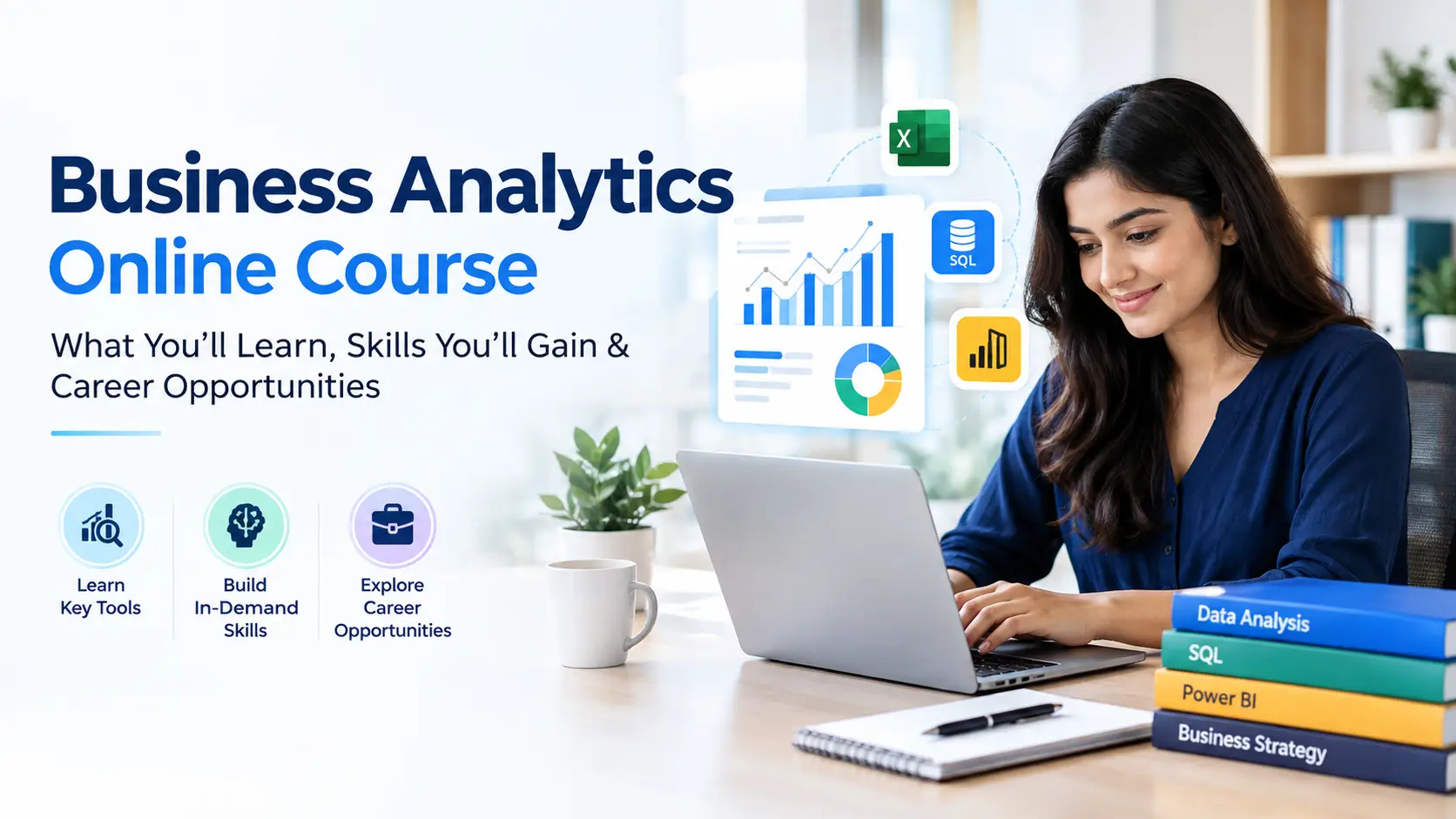
Businesses collect huge amounts of data every day. The challenge is turning that information into decisions that improve sales, operations, marketing and customer experience.
That's where business analytics comes in.
A business analytics online course enables students and working professionals to understand how to interpret business data, develop dashboards, find patterns, and communicate actionable insights. But the course itself should be more than just teaching software. It needs to relate technical skills to actual business problems.
What Is Business Analytics?
Business analytics is the use of data, statistical and quantitative analysis, explanatory and predictive modeling, and fact-based management to drive decisions and actions to support business planning.
For instance, a retailer might mine sales data to determine which items are moving, which stores are lagging and which customer demographics bring in the most money.
A business uses analytics, generally, to:
- Collecting and preparing data
- Analysing trends and patterns
- Creating reports and dashboards
- Measuring business performance
- Communicating insights
- Supporting data-driven decisions
Why Learn Business Analytics?
Analytics skills are in demand in finance, marketing, retail, operations, consulting, e-commerce, and many other business functions.
For students, education can offer a one-stop-shop for working with data. For the working professional, it is a practical way to broaden your existing business or technology skills.
A good program can help you develop:
- Data interpretation skills
- Analytical thinking
- Problem-solving ability
- Reporting and visualisation skills
- Business communication
- Practical experience with analytics tools
Significantly, just teaching people analytics doesn’t necessarily qualify them for a job. Employers might also evaluate education, experience, projects, communication, and role-specific knowledge.
What Will You Learn in a Business Analytics Online Course?
Syllabus Business analytics course content varies by provider, but a good business analytics course will take you through the entire pathway from data to insight.
1. Excel and Data Analysis
Excel is still a viable option for organizing, cleaning and analyzing business data.
You could learn formulas, pivot tables, lookups, data cleaning, charts and simple reporting.
2. SQL
SQL is used for fetching and analyzing data stored in relational database.
Core subjects might be:
- SELECT statements
- Filtering
- Sorting
- Aggregations
- GROUP BY
- Joins
- Subqueries
3. Power BI and Data Visualisation
Business analysts are frequently required to convert datasets into reports that decision-makers can easily consume.
You can also use Power BI to connect to data, transform it, create data models and publish interactive reports. The current Microsoft Power BI Data Analyst guidance focuses on data preparation, modelling, visualization, analysis and stakeholder needs.
4. Business Reporting
Analysis becomes valuable when it answers a real business question.
For example:
Question: Why did monthly sales decline?
Analysis: Compare sales by product, region, channel and customer segment.
Insight: Identify where the decline is concentrated.
Action: Give the business a clear recommendation based on the evidence.
5. Practical Projects
Projects help learners practise the complete workflow rather than simply watching software demonstrations.
A useful project might involve:
Dataset → Cleaning → Analysis → Dashboard → Findings → Business recommendation
What Skills Can You Gain?
A good business analyst course should develop both technical and professional skills.
Skill - Practical application
Excel - Analysis and reporting
SQL - Database querying
Power BI - Dashboards and visualisation
Data cleaning - Improving data quality
Data interpretation - Finding meaningful patterns
Business analysis - Understanding business requirements
Communication - Explaining findings to stakeholders
Problem solving - Investigating business issues
This combination matters because an analyst needs to understand both the data and the business question behind it.
How Does Business Analytics Work?
A simple analytics workflow looks like this:
- Define the business question
- Collect relevant data
- Clean and prepare the data
- Analyse the information
- Visualise important findings
- Interpret the results
- Communicate recommendations
- Monitor the outcome
This approach is more useful than learning individual tools in isolation.
Career Opportunities After Business Analytics Training
The business analytics qualification or course can lead to various career options as per your interest and experience.
Possible career options:
- Business Analyst
- Data Analyst
- Business Intelligence Analyst
- Reporting Analyst
- Operations Analyst
- Marketing Analyst
- Commercial Analyst
So the business analyst course in India can be attractive to graduates entering the workforce and also to professionals wanting to transition to analytics.
The Lone Star Academy provides Business Analytics training in addition to programmes in data analytics and data science. Their website course description highlights hands-on projects, assignments, interview prep, resume help, and job placement support.
How Much Do Business Analytics Course Fees Cost?
Providers and programmes will have different prices for business analytics courses.
Rather than comparing on price alone, see what the fee covers:
- Live lessons
- Recorded classes
- Hands-on projects
- Software and tools
- Mentor support
- Work assignments
- Certification
- Preparation for the Interview
- Support with your resume
- Assistance with placement
So the cheapest course isn’t necessarily the best, nor is the most expensive the worst.
Compare the learning outcomes and inclusions and then decide.
How to Choose the Best Business Analytics Course Online
When comparing top business analytics courses, use this five-step process.
Step 1: Syllabus
Relevant topics to look for are Excel, SQL, data visualisation, business reporting and applied analytics.
Step 2: Projects
Projects should require you to work with data and interpret results, not just follow a project through a tutorial.
Step 3: Learning Format
Think about if you prefer live classes, recorded lessons, classroom learning or a mix of each.
Step 4: Career Support
Before assuming that “placement support” guarantees a job, verify exactly what is covered.
Step 5: Compare Certifications Wisely
Depending on the provider, a business analytics certification may indicate course completion or assessment. Find out who issues it, what the assessment is and if it is recognized in your target role.
Online Course vs Classroom Training
Factor - Online course - Classroom course
Flexibility - Usually higher - Usually schedule-based
Location - Can study remotely - Requires attendance
Interaction - Depends on provider - Usually face-to-face
Recorded Lessons - Often available - Depends on institute
Self-discipline - Important - Less important
Best suited to - Remote learners and working professionals - Learners who prefer direct classroom interaction
Neither format is automatically better. The right choice depends on your schedule, learning style and support requirements.
How to Maintain Your Analytics Skills
Analytics tools change, so completing a course should be the beginning of continued learning.
You can maintain your skills by:
- Building new portfolio projects
- Practising SQL regularly
- Recreating dashboards from public datasets
- Following updates to analytics tools
- Reading business case studies
- Learning to explain insights clearly
- Reviewing your old projects and improving them
For learners comparing a data science institute in Delhi, data analytics courses in Delhi, data science course in Delhi or even a digital marketing course in Delhi, the same principle applies: compare the actual curriculum and learning outcomes rather than relying on course labels.
Conclusion
Business analytics is, in the end, distilling data into actionable business decisions. The software is important, but so are analytical thinking, business knowledge, communication, and hands-on experience.
While you are looking at a few best business analyst courses, keep an eye on what you will be able to do after completion of the course and not on how many tools you are going to learn or how many certificates will you get.
Lone Star Academy offers Business Analytics and allied professional education to the students and working professionals. If the programme matches your aspirations, take a look at the latest curriculum, learning mode and fees, and then contact the academy before applying.
FAQs
What is a business analytics online course?
A business analytics online course teaches learners how to analyse business data, create reports, visualise information and communicate insights for better decision-making.
Is business analytics suitable for beginners?
Yes. Beginners can start with fundamentals and progressively learn Excel, SQL, visualisation, reporting and business analysis through structured practical training.
What tools should a business analyst learn?
Commonly useful tools include Excel, SQL and business intelligence platforms such as Power BI. The right combination depends on the target role.
How much do business analytics courses cost in India?
Fees vary widely based on duration, delivery format, curriculum, projects, mentoring and career services. Compare inclusions rather than price alone.
Do I need coding to learn business analytics?
Not necessarily. Many beginner programmes start with Excel, SQL and visualisation. Some roles may require Python or other programming skills.
Which certification is best for business analytics?
There is no universal best certification. Choose credentials that match your target role, skills, assessment requirements and the technology employers expect.
What jobs can I get after a business analyst course?
Potential roles include Business Analyst, Data Analyst, Reporting Analyst, Business Intelligence Analyst, Operations Analyst and Marketing Analyst.
Is an online business analytics course worth it for working professionals?
It can be useful when the format fits your schedule and provides practical projects, feedback and skills that are relevant to your intended career direction.
What should a good business analytics course include?
A strong programme should combine business concepts, data preparation, analysis, visualisation, reporting, practical projects and opportunities to explain findings.
How do I choose the best business analytics course online?
Compare the curriculum, projects, tools, teaching format, trainer support, certification, career services, fees and expected learning outcomes before enrolling.
Related Blog: What Do You Learn in a Business Analytics Course? Skills, Tools and Real-World Applications